17 July 2026
Accounting in New Zealand
Our accountants in New Zealand provide financial/ accounting services in New Zealand. You can also rely on our chartered accountant in New Zealand.

Businesses looking for accounting in New Zealand can rely on our team of accountants. We can help with comprehensive solutions to both tax and legal matters, such as bookkeeping, payroll, end-of-year accounts, or tax and compliance support.
| Quick Facts | |
|---|---|
| Bookkeeping services in New Zealand | – accounts receivable and accounts payable management, – different bank account reconciling actions, – preparing the financial statements |
Payroll | – calculating the wages, – making the wage payments, – making the needed contributions for social security purposes |
Invoicing | – preparing and issuing invoices and proforma invoices, – tracking the issued invoices and overdue invoice reporting |
| Cash management | Commonly included as part of accounting in New Zealand, this consists of managing the company’s cash flows . |
| Reporting | Assistance for preparing the annual financial statements according to the type of company (especially for public companies). |
| Financial analysis | Part of the accounting in New Zealand there are also operational efficiency evaluations, profitability ratio calculations and more. |
| Forensic accounting | Accounting services as needed in investigations concerning fraud or money laundering investigations. |
| Tax compliance | – corporate income tax filing and payment as needed, – ongoing compliance with other taxes for companies in order to avoid unnecessary penalties |
| VAT compliance and reporting | – Goods and Services Tax (GST) registration for companies that are required to do this, – GST filing and reporting |
| Audit services offered by our accountants in New Zealand | Filing the audited financial statements for companies that are subject to this requirement (most notably, subsidiary NZ companies and others) |
| Property financial matters | – property tax compliance, – information on the taxes charged by local authorities in New Zealand |
| Statutory compliance | Assistance for complete compliance with the principles for accounting in New Zealand, IFRS adoption and implementation. |
| Tax authority assistance | Representation in front of the New Zealand Inland Revenue Department |
| Support for voluntary dissolution | Assistance for settling the debts towards creditors, distributing the remaining assets to shareholders during the liquidation process |
| Services for foreign companies | – information about foreign company taxation principles in NZ, – double taxation agreement implementation |
What accounting services do you offer?
If you are in need of accounting services in New Zealand, we can help you with the following:
- Bookkeeping: processing payments, invoices, cashflow management, reconciling bank and credit card accounts, etc.;
- Payroll: handling all matters concerning the payment of your employees’ salaries, calculating the hours and additional time worked, bonuses, payroll expense management, and relevant submissions;
- End-of-year accounts: a core part of our accounting services of accounting in New Zealand is the preparation of the final profit and loss account, the balance sheet, and other documents for the end of the financial year;
- Tax and compliance support: our accounting services help start-ups and established companies understand filing duties and applicable tax rules.
Can accounting services be tailored?
The packages and services provided by our accountants in New Zealand can be customized to meet the needs of the corporation, based on the number of employees.
How are accounting fees calculated?
In most cases, we work on an hourly basis, meaning that small companies, for which the processes handled by our chartered accountants in Auckland take less time, will pay less for their annual accounting.
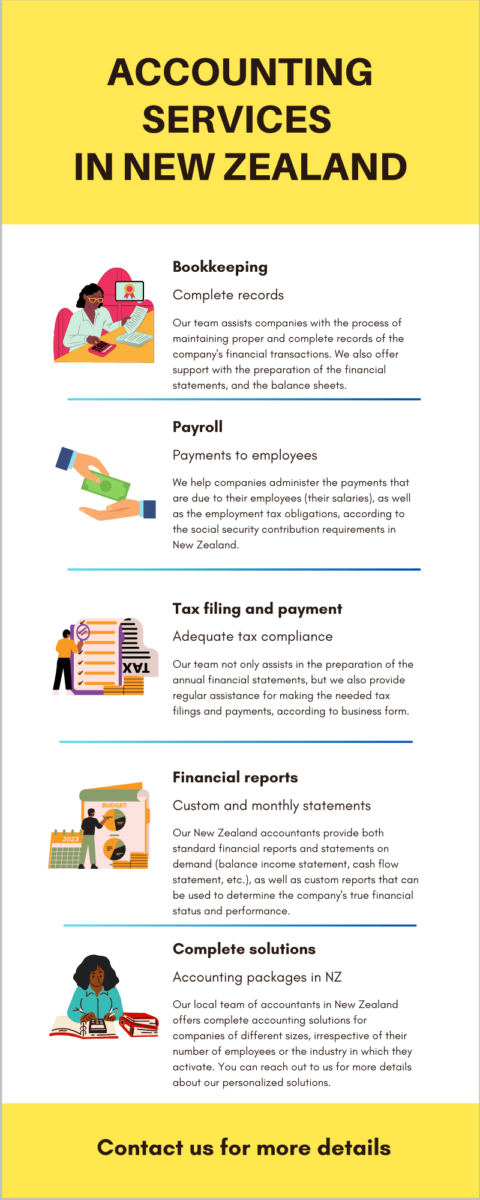
For a quick overview of our accounting services in New Zealand, please explore the infographic below:
Who issues the accounting standards in New Zealand?
The accounting standards are issued by the New Zealand Accounting Standards Board. It operates within the External Reporting Board (XRB); eligible Tier 2 entities may use the Reduced Disclosure Regime (RDR). Companies are subject to different financial reporting standards based on their revenue or assets.
Which companies may use minimum financial reporting?
- New Zealand companies that, during each of the last two accounting years, have had either a total income of NZ$33 million or less, or have assets that are NZ$66 million or less.
- New Zealand subsidiaries of multinational companies with total income of NZ$11 million or less, or assets of NZ$22 million or less in each of the last two accounting years.
- New Zealand subsidiaries of NZ companies that prepare consolidated general-purpose financial reports.
A chartered accountant in New Zealand from our team can give you more details about the principles outlined above. We also invite you to watch a short video on this topic:

Which companies must prepare financial reports to a higher standard?
- Issuers of shares or debt securities under a regulated offer, including listed issuers;
- Companies with ten or more shareholders, unless they validly opt out of higher-standard reporting;
- Companies with fewer than ten shareholders when the shareholders opt in to higher-standard reporting.
Which companies may qualify for the small-company reporting exemption?
A company may qualify if, during the income year, it was not part of a group, did not derive income of more than NZ$30,000, and did not incur expenditure of more than NZ$30,000. It must still keep the tax and employer records required by Inland Revenue.
Which companies must file audited financial statements?
Certain large New Zealand companies, all large overseas companies, and all Financial Markets Conduct (FMC) reporting entities must file annual audited financial statements.
Why is tax compliance important?
Understanding the tax and reporting principles is a key step for investors who decide to open a business in New Zealand.
Who is responsible for company compliance?
The company director is liable for the manner in which the corporation complies with many of the laws and regulations; therefore, it is in the best interests of the company’s founders to remain up to date with the tax and reporting requirements. Additionally, late filing or incomplete/inaccurate filing, as well as false statements, result in penalties.
What is the corporate income tax rate?
For most companies in New Zealand, the corporate income tax rate is 28%.
Which other taxes and employer contributions may apply?
Our accountants in New Zealand highlight the main taxes for companies below:
- Resident withholding tax (RWT) is 33%, less imputation credits. Non-resident withholding tax (NRWT) depends on the dividend and applicable double tax agreement (DTA);
- Goods and Services Tax: the New Zealand equivalent of the value-added tax has a standard rate of 15% and a reduced rate of 0%; Goods and Services Tax (GST) registration generally starts at NZ$ 60,000 of taxable turnover over 12 months;
- KiwiSaver employer contribution: the default matching employer contribution is 3.5% from 1 April 2026. An employee may apply for a temporary reduction to 3%, and the employer may choose to match that temporary rate.
- There is no payroll tax, transfer tax, stamp duty, or capital duty;
- Fringe benefit tax (FBT): an employer may need to pay FBT on non-cash benefits such as motor vehicles available for private use, low-interest loans, subsidized transport, free or discounted goods and services, gift cards, and employer contributions to employee funds or schemes.
Can company losses be carried forward?
Generally, losses can be carried forward indefinitely, with a 49% continuity requirement for the ultimate share ownership. Losses can be offset against the profits of other group companies, subject to conditions. The business continuity test may provide an alternative when its conditions are met.
Can businesses claim foreign tax credits?
Businesses can access a foreign tax credit against New Zealand income tax, which applies to foreign income. However, the credit is limited to the lesser value of the effective foreign tax paid on the foreign income.
Is there a tax incentive for research and development?
Companies undertaking eligible research and development (R&D) activities may claim a 15% tax credit for eligible expenditure.
The standard minimum eligible R&D expenditure is NZ$50,000 a year, and the maximum is NZ$120 million a year. Expenditure through an approved research provider can qualify even when the business does not meet the NZ$50,000 minimum.
What are the main benefits of working with our team of specialists in New Zealand?
Some of the main reasons for working with our team include the following:
- You will save time: our team will focus on financial compliance while you focus on growing your business;
- Lower costs: in most cases, from a financial point of view, it is more convenient to outsource accounting than to hire an internal team to handle the needed operations;
- Accurate reporting: when you choose to work with an experienced team, you can rest assured that your financial reports will be accurate and drawn up in compliance with the laws in force;
- Expert advice: as we have previously said, we not only provide accounting services, but also expert advice and analysis.
What accounting records must I keep in New Zealand?
In order to prepare accurate accounts and tax returns, you must keep records of your:
- business income;
- sales;
- purchases;
- expenses;
- invoices;
- bank transactions.
Inland Revenue generally requires you to retain these records, including electronic documents, for at least seven tax years.
Our accountants from New Zealand can organize your records, reconcile transactions, and ensure that the information remains accessible if your business is audited. Accurate record keeping also allows you to monitor cash flow and prepare financial and tax reports more efficiently.
How does provisional tax affect my business?
You will generally have to pay provisional tax if the residual income tax calculated in your previous return exceeded NZD 5,000. Instead of paying the entire amount at the end of the year, you make installment payments during the following tax year.
Therefore, it is important to collaborate with professional accountants so they can assist you in the process for a better understanding and management of the entire cash flow of your business.
Why do companies outsource accounting?
Many companies in New Zealand choose to outsource their accounting to benefit from cost savings and timely, reliable services. We are one of the accounting firms in New Zealand that offer complete solutions to companies of all sizes, as well as across many different industries.
Contact our accountants in New Zealand for more information about our services.